When AI Watches Over Animals Instead of People
Camera traps, acoustic sensors, and a quieter revolution in conservation.
 Sahir Maharaj9 min read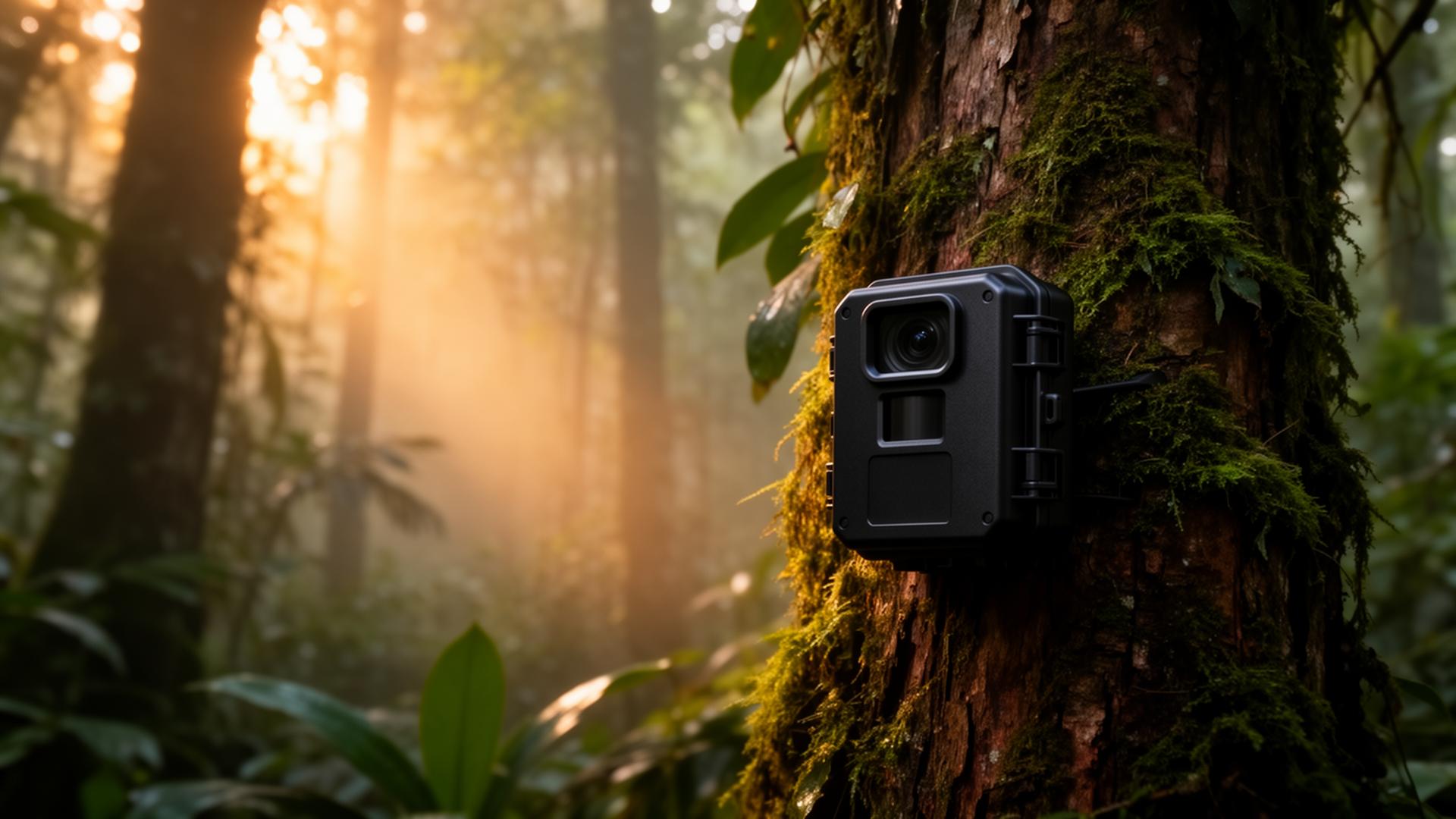
Somewhere deep in a forest you will never visit, a camera just took a photo. There was no researcher behind the lens. No ranger crouching in the undergrowth. Just a weatherproof box bolted to a tree, a motion sensor, and a machine learning model quietly doing its job. Within seconds, the image is classified. Species identified. Behavior logged. Location timestamped. And somewhere in a lab, a conservation biologist who used to spend six months of the year sorting through blurry images of leaves is now doing something far more interesting with that data. This is not a pilot program or a proof of concept. This is happening right now, across forests, savannas, coral reefs, and mountain ranges, and it is quietly changing what conservation actually looks like.
I find this topic genuinely moving, and I do not say that about many technology stories. Conservation has always been one of those fields where the scale of the problem and the scale of the resources available are heartbreakingly mismatched. There are species disappearing faster than we can count them. There are ecosystems under pressure from poaching, climate change, and habitat loss all at once. And there are small, underfunded teams of researchers trying to track, protect, and understand it all with limited time, limited budgets, and only so many hours in a day. AI does not solve all of that. But it does something important: it gives those teams a force multiplier they have never had before.
The thing that strikes me most is how quietly this transformation is unfolding. We hear a lot about AI in healthcare, in finance, in education. But the story of AI standing watch over the last wild places on earth gets far less attention than it deserves. There is something almost poetic about it. The same technology powering ad algorithms and recommendation engines is also, right now, listening for the call of an endangered bird in the Amazon.
If you have ever spoken to a field ecologist about their work, there is a phrase you will hear again and again: the data problem. Not a shortage of data, exactly, but a crushing abundance of raw, unstructured, unprocessed data that no human team could ever get through in time to act on it meaningfully. Camera traps alone can generate hundreds of thousands of images a month across a single reserve. Acoustic monitors record tens of thousands of hours of soundscape data every year. Satellite imagery produces more spatial data than any team could manually analyze. The bottleneck was never the sensing. It was always the sense-making.
Machine vision systems trained on thousands of labeled wildlife images can now identify species, estimate ages, flag individual animals by markings, and detect behavioral anomalies faster than any human reviewer. What used to take a team of researchers six months to process can now be turned around in hours. And it is not just faster. It is more consistent. A tired researcher at the end of a long data session misses things. The algorithm does not get tired. It processes the ten-thousandth image with the same attention it gave the first.
The acoustic side of this is just as remarkable. AI models trained on bird calls, whale songs, and primate vocalizations can now monitor entire soundscapes in real time, flagging when a species previously absent from an area makes an appearance, or when a normally vocal population goes suddenly quiet, which can itself be an early warning signal for habitat disruption. It is a kind of presence that was simply not possible before.

It would be easy to tell this as a pure success story, and the temptation is real because the outcomes are genuinely exciting. But there are complications worth taking seriously. The first is the training data problem. AI models are only as good as the data they were trained on, and in wildlife conservation, that data is deeply uneven. Species that live near research stations, that have been studied for decades, that happen to be photogenic enough to attract scientific attention, are well represented. The obscure invertebrate living in a rarely-visited wetland in a low-income country is not.
There is also a significant access and infrastructure gap that rarely makes it into the headline stories. The most sophisticated AI wildlife monitoring systems require connectivity, power, computing resources, and technical expertise to deploy and maintain. Many of the most ecologically critical and most threatened regions in the world also happen to be the most remote and least resourced. If the benefits of AI in conservation flow primarily to places that were already relatively well-equipped, the technology risks widening the gap rather than closing it.
And then there is a subtler concern about what happens to the human knowledge embedded in conservation work when AI becomes the primary observer. The rangers who have spent twenty years walking the same land know things that no algorithm has ever been trained on. They notice when the behavior of a herd shifts in a way that feels wrong, even if they cannot immediately explain why. They carry ecological knowledge that is relational, contextual, and embodied in ways that are genuinely difficult to digitize.
What excites me most about where this is heading is the shift from reactive to predictive conservation. For most of its history, wildlife conservation has been, by necessity, a discipline of responses. A population crashes, and researchers scramble to understand why. A species disappears from a region, and teams are deployed to investigate. The feedback loops have always been slow, often too slow to make a meaningful difference. AI systems that can monitor continuously and identify trends as they form offer something genuinely new: the ability to see a problem developing before it becomes a crisis.
We are already seeing early versions of this in the field. Thermal drone systems monitoring elephant herds can detect unusual movement patterns that correlate with poaching activity before any incident occurs. Predictive models built on years of camera trap data can forecast where wildlife corridor usage is likely to decline, giving land managers the lead time to intervene. Acoustic models tracking fish populations in coral reef ecosystems can flag stress indicators months before visible bleaching events.
At its best, AI in wildlife conservation is not replacing the human beings who have dedicated their lives to protecting the natural world. It is giving them something they have always deserved but rarely had: enough information, delivered in time, to actually make a difference. The forests and oceans and grasslands that remain are not going to save themselves, and neither are the species that depend on them. But somewhere between the camera bolted to a tree and the researcher staring at a screen full of data, there is a version of the future where the race between human impact and conservation response finally gets a little less one-sided.
Topics in this article
You might also like
View all
Can AI Save the Planet It's Helping to Destroy?
The uncomfortable, two-sided story of AI and climate change.
The Hidden Cost of Asking AI Anything
Every prompt has a power bill. The carbon and water cost behind every AI answer.
AI That Kills: Who Gave Them Permission?
Lethal autonomous weapons are no longer science fiction. The accountability gap is terrifying.